We are thrilled to highlight some of the opportunities, projects, research and consultations that are currently being worked on within the wider Haematology community and beyond.
Are you a medical student, intern, or resident interested in choosing hematology as your specialty?
EHA offers mentorship and guidance to get familiar with hematology as a clinician and/or researcher. The program aims to provide you with a clearer idea of what hematology entails from a practical point of view and get a head start in the field.
More information can be found on their website.
The Royal College of Pathologists is recruiting new audit evaluators for haematology.
Applicants should be Fellows of the College, have knowledge of the clinical audit process and be experienced in undertaking high-quality clinical audit. Evaluators are responsible for evaluating whether the criteria and standards of audits for certification are met appropriately for your own specialty.
To apply please submit an abridged CV and a statement in support of your application (no more than 500 words), explaining how your skills and experience meet the person specification and how you would approach the role if appointed. For further information about the role, and to apply please contact Maria Marrero Feo via [email protected]
For all haematology trainees with an interest in AML
The UK AML Research Network is a collaborative initiative with a focus on developing and reviewing national and global clinical trials, advancing scientific research and improving UK-wide clinical practice; ultimately improving outcomes for patients with AML. There is a central steering committee in addition to several sub-groups including transplant and cellular therapy, supportive care, fit and unfit, relapse, registry and scientific sub-groups.
We are aiming to set up an AML trainee subgroup which will involve trainees meeting on a fairly regular basis (likely over Teams every 3-4 months) where we will discuss the latest clinical trial developments and recent interesting publications, as well as acting as a forum through which we can reach out to trainees who would like involvement in upcoming projects and trials. We will also aim to have trainees present their own work, which can ultimately lead to presenting in front of the AML community as a whole at the annual AML Academy.
If you would like to be involved in the trainee subgroup please email either Sam ([email protected]) or James ( [email protected]) so we can gauge initial interest! Can you please include your full name, stage of training, Deanery and hospital, and whether you have any specific areas of interest within AML.
We would hope to meet virtually in the next couple of months to introduce ourselves and provide a brief update following the upcoming AML Steering Group Meeting.
The Royal College of Physicians are looking for responses to the RCP’s snapshot survey asking about members’ recent experiences of working in the NHS, and their views on Advice and Guidance, long-term conditions, delayed discharge and alcohol harms.
This snapshot survey will help us to advocate for patients and physicians.
Please share your experiences in our snapshot survey before 11:59pm on 21 June 2026. Gathering the insight and experience of our members is vital. It helps us to get our message across in the media and puts pressure on the NHS and government to change things for the better.
Projects, consultations and research
It has been identified that there is a gap in the process of how patients, both adult and paediatric, are consented for bone marrow aspirates and trephines. In addition, the training and accreditation process is extremely variable in different centres. This is both nationally and internationally. Under the BSH General Haematology Task force's umbrella, we have agreed a Guideline writing group to address this. We would be very grateful if you could please complete the following survey, as the information gathered will form the basis of the next step of our work.
https://docs.google.com/forms/d/e/1FAIpQLSc4dqsYz_LBD6JJFuG21CIxEL94hEzVkGCx5eAjGMFwpFMvhw/viewform
Many thanks,
Jayashree Motwani.
Consultant Paediatric Haematologist,
Birmingham Children's Hospital
Vice-Chair of the BSH Paediatric SIG.
Blastic Plasmocytoid Dendritic Cell Neoplasm (BPDCN) International Registry
We would like to ask for your contribution in the BPDCN International Registry project.
By joining our registry, you will help us:
- to create a large database of patients with BPDCN and
- to investigate the characteristics and outcome of disease with different treatment regimens,
- to evaluate prognostic factors,
- to generate data-based prospective treatment recommendations.
You can register your interest to participate using this link:
https://docs.google.com/forms/d/1uykOE9PiaCXJ-E5snP8gPXxRN7RA7r4_PULR-oAvTSg/edit?ts=63a5a605
Dr Astghik Voskanyan
We would like to ask for your contribution in the MRC funded project that is developing reporting guidelines for randomised controlled trials (RCTs) protocols and reports using surrogate primary endpoints: the SPIRIT-SURROGATE and CONSORT-SURROGATE extensions.
By taking part in our survey, you will help us to develop guidelines for reporting RCTs with surrogate primary endpoints. The survey will ask for your views on the most important items that should be reported by RCTs reports and protocols using surrogate endpoints.
We are particularly interested in the views of people who:
• have expertise or interest in surrogate endpoints with basic understanding of the concept of surrogacy in RCTs
• are implementers or end users of interventions that use surrogate endpoints (e.g., patient and public representatives, healthcare professionals)
• have expertise and are interested in RCTs reporting and methodology (e.g., researchers journal editors, statisticians, methodologists)
• are interested in the design and reporting of trials using surrogate endpoints (e.g., journal editors, funders, regulators).
You can register your interest to participate using this link: https://forms.office.com/r/1UuDCBU8bc
Many thanks,
Dr Anthony Manyara, Prof Rod Taylor, and Prof Oriana Ciani on behalf of the SPIRIT|CONSORT-SURROGATE Project Team
Dr Rachel Rosovsky is a Haematologist, based at Harvard, leading in the survey of current anticoagulation practice in the management of Covid-19 patients
The survey takes 5-10 min to tell us about if and how anticoagulation practice has changed given the publication of the multiplatform, RAPID, and HEP-Covid trials: https://redcap.partners.org/redcap/surveys/?s=HFJJ38THP4
About HaemSTAR
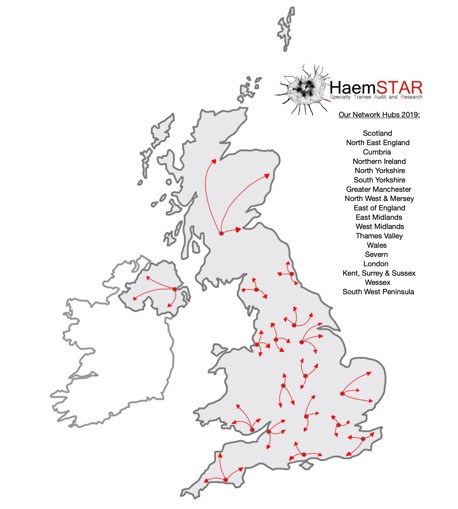
HaemSTAR is a national network of haematology registrars aiming to promote and create research in non-malignant haematology. One of the areas we promote is audit.
There is often difficulty in recruiting patients to audits for non-malignant disease, either due to reduced investment into projects relative to malignant haematology audits, or because of the rarity of conditions such as TTP.
The aim of HaemSTAR is to use a central committee to either create non-malignant audits, or to promote audits started in trusts around the country to enhance uptake.
The committee then disseminate information about these studies to regional leads in each training region. These regional leads then disseminate that information to their registrar colleagues. This allows potentially for every haematology registrar nationally, and subsequently their consultants, to be informed about these projects, hugely increasing potential project recruitment.
We have very positive data from the projects we have completed so far, including an audit of IVIG use in ITP which accrued 975 patients in 39 centres nationally.
The benefits for those who registrars or consultants who contribute is that audit proformas and registration information for audit departments are prepared for them, their data is analysed for them and that they can achieve ‘citable collaborator’ status if they have given sufficient contribution on any papers published from those audits.
Further information can be found on our website; www.haemstar.org or by contacting [email protected]. This can be useful for consultants in hospitals with no registrar presence so they can receive our monthly Newsletter which explains our current projects.