In 2016, representatives from the British Society for Haematology (BSH) and haematologists from low- and middle-income countries (LMIC) met to decide the priorities of the Global Haematology Special Interest Group (SIG).
One priority was identifying BSH speakers to visit LMIC haematology meetings to establish links and collaborative projects.
We built on the success of the 2017 pilot project to establish the Plenary Speaker Project as a core activity of the SIG. In 2023, we rebranded the scheme as BSH Global Speakers to better communicate our vision for the project,
Applications are now open for societies to request a BSH-sponsored global speaker.
The BSH Global Speakers scheme aims to form international partnerships with haematology societies in LMICs to share knowledge and expertise.
We have previously funded UK-based speakers selected by BSH to travel to face-to-face meetings, financially supporting economy return international flights, accommodation and subsistence for the speakers.
Society applicants are encouraged to use this initiative to collaborate on, e.g. co-authored evidence-based guidelines or research to improve evidence and treatment in your setting.
If your society is planning a conference or meeting in 2027, we welcome you to apply for a speaker.
Please email our Volunteer Support Officer, Asia Parvez for an application form.
Deadline: Friday 30th October, 2026.
About the programme
Making links, creating networks
The initial phases of this programme involved mapping out and making contacts with active haematology and transfusion societies in LMICs worldwide.
We searched for active haematology societies in LMICs in Africa, Europe, the Middle East and Asia.
We contacted attendees from LMICs at the 2016 BSH international congress, and we asked respondents about active haematology societies in their region. We conducted internet searches and contacted haematologists and transfusion specialists in large teaching hospitals in LMICs.
We shortlisted LMIC haematology societies for our 2017 pilot scheme based on pre-defined criteria. We invited the Ghanaian Society of Haematology (GHASH) and the Haematology and Oncology Society of Africa (HOSA) to take part.
Previous attendees:
2017: Dr Hume Ahmad - Accra, Ghana - Challenging diagnostic cases in anaemia.

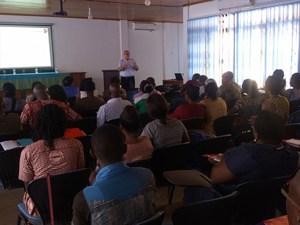
2017: Dr Maadh Aldouri - Nairobi, Kenya - Treating lymphoma in low resource settings.

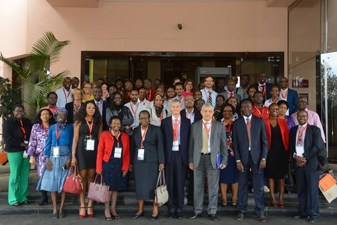
2018: Dr Noemi Roy - Cairo, Egypt - Dyserythropoesis and the use of NGS in rare anaemias.
2019: Dr Anita Hill - Colombo, Sri Lanka - Update in PNH.
2019: Dr Ben Kennedy - Bangkok, Thailand - Update in CLL.
2021: Dr Jecko Thachil - South Africa - Coagulopathy and COVID-19.
2021: Dr Nandini Sadasivam - Vietnam - Update in care for patients with thalassaemia.
2022: Dr Richard Dillon - Egypt - Molecularly guided interventions to prevent relapse in AML.
2022: Dr Keith Gomez - Ghana - Anticoagulation: challenging cases.
2023: Dr Bill Grey - Thailand - Targeting protein homeostasis to eradicate acute myeloid leukaemia stem cells and protect health issues.
2023: Miss Lucy Wheeler - Egypt - MRD in acute leukaemia: a 'different from normal' approach.
2024: Dr Jecko Thachil – Vietnam – Von Willebrand disease.
2025: Dr David Reese - Cairo, Egypt - Challenges in the diagnosis and management of rare anaemias.
2025: Prof. Mickey Koh - Myanmar - Stem cells and cellular therapy.